Is Land Banking Profitable in Kenya? Real Returns After Costs and Inflation
August 30, 2026
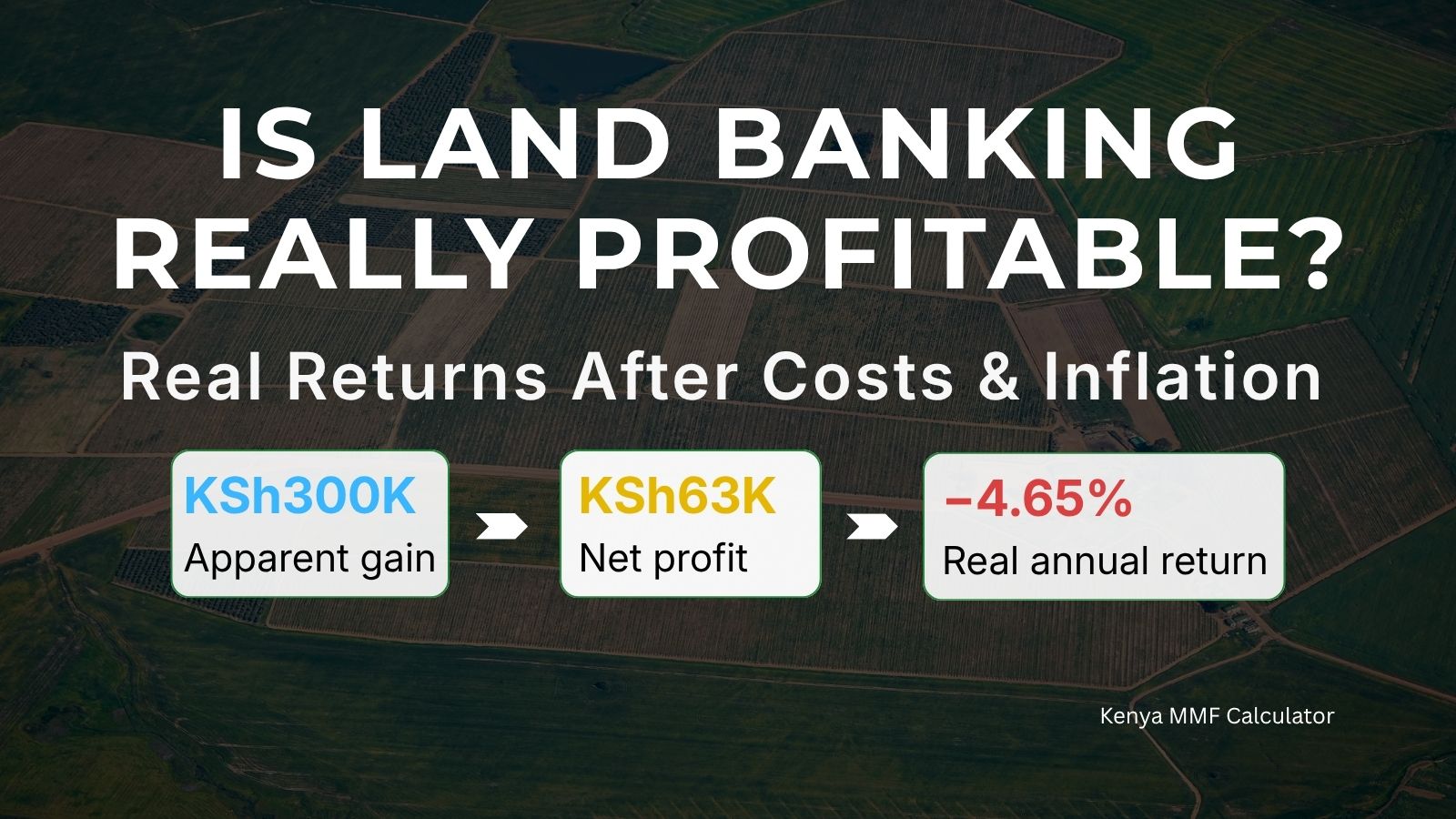
Buying land and waiting for its price to rise is one of Kenya’s most familiar investment strategies. A plot bought for KSh400,000 may later be advertised as being worth KSh700,000, KSh1 million or more. The difference is then presented as proof that land always appreciates.
But a higher selling price does not, by itself, tell you whether the investment performed well.
To establish the real return from land banking, you need to know:
- how many years the land was held;
- how much was spent when buying it;
- what it cost to own and protect it;
- what was deducted when selling it;
- how much capital gains tax was payable;
- how much inflation reduced the value of the money; and
- what the same capital could have earned elsewhere.
This article uses a practical ten-year example to show why a seemingly impressive land profit can become much smaller when measured correctly.
Key takeaway: If a KSh400,000 plot rises to KSh700,000 over ten years, its price grew by 75%, but only 5.76% per year before costs. After the itemised costs and tax used in this article, the annualised return falls to approximately 1.07%, well below assumed inflation of 6%.
What is land banking?
Land banking generally means buying undeveloped land and holding it in anticipation of future appreciation. The expected increase may be driven by population growth, a new road, electricity, water, schools, commercial activity or the outward expansion of a town.
Unlike a completed rental property, idle land normally produces no monthly income. The investor’s return therefore depends primarily on selling the land later for substantially more than the total amount spent.
That can work very well when the investor buys at a fair price in an area that experiences genuine demand. It can perform poorly when the purchase price already includes years of expected development, infrastructure is delayed, the title has problems or buyers remain scarce.
Land is not automatically a good or bad investment, your result depends on the numbers.
The mistake: focusing only on the nominal profit
Assume an investor buys a plot for KSh400,000 and sells it ten years later for KSh700,000.
The obvious calculation is:
\[\text{Nominal profit}=\text{KSh700,000}-\text{KSh400,000}=\text{KSh300,000}\]The cumulative price increase is:
\[(\text{KSh300,000}\div\text{KSh400,000})\times100=75\%\]A 75% increase sounds attractive. However, it occurred over ten years—not one year.
Convert the gain into an annual return
The appropriate measure for growth over several years is the compound annual growth rate, commonly abbreviated as CAGR.
\[\text{CAGR}=\left(\frac{\text{Final value}}{\text{Initial value}}\right)^{1/n}-1\]In this formula, n is the number of years.
For the KSh400,000 plot sold for KSh700,000 after ten years:
\[\left(\frac{700,000}{400,000}\right)^{1/10}-1=5.76\%\]The land’s price therefore increased by approximately 5.76% per year before costs, tax and inflation.
That is a much more useful figure than saying it made a 75% return.
How different selling prices affect the annual return
The following table assumes a KSh400,000 purchase price and a ten-year holding period. It initially excludes all costs and taxes so that we can isolate price growth.
| Selling price after 10 years | Nominal gain | Cumulative return | Annualised price growth |
|---|---|---|---|
| KSh500,000 | KSh100,000 | 25% | 2.26% |
| KSh700,000 | KSh300,000 | 75% | 5.76% |
| KSh800,000 | KSh400,000 | 100% | 7.18% |
| KSh1,000,000 | KSh600,000 | 150% | 9.60% |
| KSh1,500,000 | KSh1,100,000 | 275% | 14.12% |
Even doubling the price from KSh400,000 to KSh800,000 produces annual growth of only 7.18% over ten years.
This is not necessarily poor, but it is very different from earning 100% every year—or even 10% per year.
Costs incurred when buying land in Kenya
The purchase price is not the investor’s complete cost.
Depending on the transaction, a buyer may pay for:
- stamp duty;
- legal and conveyancing services;
- official searches and due diligence;
- valuation;
- registration and title fees;
- survey or mutation work;
- consent fees;
- transport and site visits; and
- financing costs when borrowed money is used.
The State Department for Lands lists land-transfer charges of KSh1,000, a KSh2,500 title fee and stamp duty at either 2% or 4% of the property value. Stamp duty is based on the assessed property value, not necessarily the lower price written in a private agreement.
The 2% rate generally applies to rural property, while the 4% rate generally applies to urban property. On land valued at KSh400,000, that would be:
| Classification | Stamp-duty rate | Stamp duty on KSh400,000 |
|---|---|---|
| Rural | 2% | KSh8,000 |
| Urban | 4% | KSh16,000 |
Legal fees depend on the property’s value, the work involved and the applicable remuneration rules or fee agreement. Obtain a written quotation rather than relying on a universal percentage.
Costs incurred while holding land
Vacant land may not send you a monthly bill, but it is not always cost-free.
Possible holding expenses include:
- land rates charged by the county government;
- land rent on leasehold property;
- clearing vegetation;
- replacing beacons;
- fencing and fence repairs;
- security or caretaker payments;
- travel to inspect the property;
- resolving boundaries or encroachment; and
- interest on a loan used to buy the land.
Some plots will incur almost none of these costs. Others will require repeated spending. Keep receipts and records because qualifying acquisition, legal, valuation, financing and enhancement costs may also be relevant when calculating capital gains tax.
Costs incurred when selling land
The selling price is not necessarily the amount deposited into the seller’s account.
Potential deductions include:
- estate-agent commission;
- advertising;
- valuation;
- legal fees;
- obtaining documents or consents;
- settling outstanding land rent or rates; and
- capital gains tax.
Agent commissions are negotiable and should not be treated as a fixed statutory percentage. This article uses 3% only as an illustrative assumption.
Capital gains tax on land in Kenya
The Kenya Revenue Authority currently charges capital gains tax at 15% of the net gain. It is paid by the seller or transferor.
KRA gives the calculation as:
\[\text{Net gain}=(\text{Transfer value}-\text{incidental transfer costs})-\text{adjusted cost}\]The adjusted cost can include the acquisition price, incidental acquisition costs and qualifying enhancement costs. KRA identifies items such as legal fees, valuation expenses, advertising, mortgage interest and enhancement costs among potentially allowable expenses. Its capital gains tax guidance should be checked when preparing an actual return.
Capital gains tax is not simply 15% of the selling price. It is generally 15% of the calculated net gain.
A complete worked land-banking example
Now return to the plot bought for KSh400,000 and sold for KSh700,000 after ten years.
The following costs are hypothetical but plausible. They are included to demonstrate the calculation, not to prescribe what every transaction will cost.
Purchase and holding costs
| Item | Assumption |
|---|---|
| Purchase price | KSh400,000 |
| Rural stamp duty at 2% | KSh8,000 |
| Legal and due-diligence costs | KSh25,000 |
| Transfer and title charges | KSh3,500 |
| County land rates or land rent over ten years | KSh30,000 |
| Initial fencing and subsequent repairs | KSh60,000 |
| Clearing and basic maintenance | KSh20,000 |
| Site visits and transport | KSh20,000 |
| Total cash spent | KSh566,500 |
These figures are deliberately itemised so that costs do not disappear inside a vague miscellaneous allowance. County charges vary by location, valuation and tenure. A remote plot may also cost considerably more to fence, inspect and protect. Conversely, some owners will spend less than these assumptions.
The table does not treat a legal dispute as inevitable. Dispute expenses are considered separately below because many plots will never face litigation, while a serious title, succession, boundary or access case can cost far more than a token allowance.
Selling costs and tax
Assume:
- selling price of KSh700,000;
- agent commission of 3%, or KSh21,000;
- legal, advertising and valuation costs of KSh15,000; and
- a CGT adjusted cost of KSh436,500, excluding ordinary holding costs that may not qualify.
The transfer value after the assumed incidental selling costs is:
\[\text{KSh700,000}-\text{KSh21,000}-\text{KSh15,000}=\text{KSh664,000}\]The estimated taxable net gain is:
\[\text{KSh664,000}-\text{KSh436,500}=\text{KSh227,500}\]Estimated capital gains tax is:
\[\text{KSh227,500}\times15\%=\text{KSh34,125}\]The investor’s approximate net sale proceeds are therefore:
\[\text{KSh700,000}-\text{KSh21,000}-\text{KSh15,000}-\text{KSh34,125}=\text{KSh629,875}\]Compared with total cash spending of KSh566,500, the remaining nominal profit is:
\[\text{KSh629,875}-\text{KSh566,500}=\text{KSh63,375}\]The apparent KSh300,000 gain has fallen to approximately KSh63,375 after the itemised costs and tax.
The annualised return after costs and tax
For a simple conservative comparison, treat the KSh566,500 total expenditure as though it were committed at the beginning. The approximate annualised return becomes:
\[\left(\frac{629,875}{566,500}\right)^{1/10}-1=1.07\%\]This method slightly understates the return because some holding expenses would have been paid later rather than on the purchase date. A precise personal calculation should use the dates of every cash flow and calculate an internal rate of return.
Nevertheless, it shows why costs cannot be ignored:
| Measurement | Result |
|---|---|
| Increase in advertised price | 75.00% |
| Annualised price growth before costs | 5.76% |
| Nominal profit after itemised costs and CGT | KSh63,375 |
| Approximate annualised return after costs and CGT | 1.07% |
What if the land becomes involved in a legal dispute?
Legal disputes should not be hidden inside the normal-cost calculation, but they should not be ignored either. A buyer may face a boundary disagreement, succession claim, double allocation, access-road dispute, encroachment or challenge to the seller’s authority.
There is no honest universal figure for such a dispute. The cost depends on whether the issue is resolved through document correction, negotiation, tribunal proceedings or full litigation. Expenses can include advocate fees, survey work, valuation, travel, filing fees and years of delayed sale or development.
As a modest stress test, add a KSh50,000 legal contingency to the example:
| Possible event | Total cash spent | Net sale proceeds | Nominal profit | Approx. annualised return |
|---|---|---|---|---|
| No dispute | KSh566,500 | KSh629,875 | KSh63,375 | 1.07% |
| KSh50,000 dispute cost | KSh616,500 | KSh629,875 | KSh13,375 | 0.21% |
At 6% inflation, the dispute scenario produces an approximate real return of negative 5.46% per year. A complex dispute could cost much more than KSh50,000 and may prevent the land from being sold at all until it is resolved.
The better protection is not merely budgeting for litigation. It is reducing the probability of a dispute through independent legal advice, official searches, survey verification, physical boundary checks, seller-identity verification and confirmation of succession or spousal-consent requirements before payment.
What inflation does to the return
Assume inflation averaged 6% per year during the ten-year holding period.
The exact real-return formula is:
\[\text{Real return}=\frac{1+\text{nominal return}}{1+\text{inflation}}-1\]Using the approximate 1.07% annual return:
\[\frac{1.0107}{1.06}-1=-4.65\%\]The investment therefore produced an approximate real return of negative 4.65% per year under the no-dispute assumptions.
The seller received more shillings than the original purchase price but lost purchasing power.
The inflation break-even price
If there were no transaction costs, KSh400,000 would need to grow to approximately KSh716,339 after ten years merely to match 6% annual inflation:
\[\text{KSh400,000}\times(1.06)^{10}=\text{KSh716,339}\]That means selling at KSh700,000 would already fall slightly below inflation before considering stamp duty, legal fees, holding expenses, agent commission and CGT.
Under the full no-dispute assumptions above, the estimated gross selling price required to preserve purchasing power rises to approximately KSh1.11 million. This estimate treats part of the fencing cost as an initial expense, spreads the remaining ownership costs across the ten years, and then accounts for the assumed selling costs and CGT.
That is not a universal break-even price. It demonstrates how much the answer changes when all cash flows are included.
Opportunity cost: what could the money have earned elsewhere?
Opportunity cost is the value of the best reasonable alternative you did not choose.
If KSh400,000 could earn a consistent net return elsewhere and all proceeds were reinvested, its approximate value after ten years would be:
| Assumed net annual return | Value after 10 years |
|---|---|
| 6% | KSh716,339 |
| 8% | KSh863,570 |
| 10% | KSh1,037,497 |
| 12% | KSh1,242,339 |
| 14% | KSh1,482,889 |
These are mathematical scenarios, not forecasts or guaranteed Treasury-bill, bond or money-market-fund returns. Rates change, taxes differ and every alternative carries its own risks.
However, they show why “I made KSh300,000” is not enough information. If another investment with comparable risk and acceptable liquidity would have produced substantially more, the land carried a meaningful opportunity cost.
For another example of why advertised investment rates can differ from the amount investors actually retain, read Treasury Bill Returns in Kenya: What You Actually Earn After Tax and Inflation.
Land has advantages that a spreadsheet may not capture
A numerical comparison should not ignore the genuine advantages of land.
Depending on the property, land may:
- benefit from an unexpected infrastructure project;
- be developed into a home, business or rental property;
- generate farming, parking, storage or leasing income;
- provide collateral, subject to a lender’s requirements;
- offer personal or strategic value; and
- appreciate sharply when an area transitions to a higher-value use.
Land returns can also be highly uneven. A plot may appear stagnant for years and then rise quickly after a road, university, factory or housing development is announced.
The challenge is that these outcomes are difficult to forecast and are often already included in the seller’s asking price.
Risks commonly overlooked in land banking
1. Title and fraud risk
A visually attractive plot is worthless if the seller cannot transfer a valid interest. Conduct official searches, verify identity and ownership, confirm consents and use an independent advocate.
2. Liquidity risk
Land does not have a continuously quoted market price. Finding a buyer at the desired price can take months or years, particularly in speculative locations.
3. Asking-price illusion
Nearby plots may be advertised at KSh1 million without actually selling at that price. Use completed transactions and professional valuations where possible, not online asking prices alone.
4. Infrastructure speculation
“A major road is coming” is not the same as a funded, approved and active project. Verify planning documents and construction progress.
5. Boundary and access problems
Confirm the parcel’s boundaries, beacons, access road and any easements. A plot that exists on paper but lacks practical access may be difficult to develop or resell.
6. Idle-capital risk
Vacant land may produce no income while still requiring rates, security, maintenance and travel. The longer the holding period, the more important this becomes.
7. Concentration risk
For many buyers, one plot consumes most of their investable savings. Their outcome then depends heavily on one location and one buyer eventually accepting the price.
How to evaluate a land-banking offer
Before buying, create three scenarios rather than relying on the seller’s projection:
Conservative scenario
- Infrastructure is delayed.
- The land grows slowly.
- Selling takes longer than expected.
- Costs are higher than estimated.
Base scenario
- Development proceeds gradually.
- The land appreciates at a moderate rate.
- A buyer is found within a reasonable period.
Optimistic scenario
- Infrastructure and demand arrive quickly.
- The area transitions to a higher-value use.
- The land sells without a large discount.
For each scenario, calculate:
- Expected selling price
- Holding period
- Purchase and ownership costs
- Selling costs
- Capital gains tax
- Net sale proceeds
- Annualised return
- Real return after inflation
- Return from a reasonable alternative
If the investment works only in the optimistic scenario, the asking price may not provide enough margin for error.
Records every land investor should keep
Keep evidence of:
- the sale agreement and purchase price;
- proof of every payment;
- stamp-duty assessment and receipt;
- legal and valuation invoices;
- official-search and registration charges;
- survey, consent and mutation expenses;
- financing costs;
- documented enhancements;
- advertising and agent fees; and
- the eventual sale and transfer costs.
These records help you calculate the true return and may support allowable-cost claims when determining capital gains tax.
Final thoughts
Land banking can produce strong returns, particularly when an investor buys below fair value in an area with genuine, verifiable demand. But land does not become a successful investment merely because its price rises.
In the example used here, a plot bought for KSh400,000 and sold for KSh700,000 appeared to generate a KSh300,000 profit. The annualised price growth was only 5.76%. After itemised buying, county, fencing, maintenance, transport and selling costs plus capital gains tax, the approximate nominal profit fell to KSh63,375 and the annualised return to 1.07%. A modest KSh50,000 dispute cost reduced the nominal profit further to KSh13,375.
At 6% inflation, that represented a loss of purchasing power.
Before buying land as an investment, calculate the return from the complete cash flow, not just the difference between two prices. Then compare the result with inflation and with realistic alternatives of similar risk.
FAQ
What is land banking?
Land banking is the purchase of undeveloped land with the intention of holding it until demand, infrastructure or development increases its value. The investor normally relies primarily on future price appreciation rather than current rental income.
Is land banking profitable in Kenya?
It can be profitable, but the purchase and sale prices alone do not prove it. Investors should calculate the annualised return after stamp duty, legal fees, holding costs, selling costs, capital gains tax and inflation.
How much stamp duty is charged when buying land in Kenya?
The State Department for Lands lists stamp duty of 2% or 4% of the property value. The applicable rate generally depends on whether the property is classified as rural or urban and on the official valuation.
What is the capital gains tax rate on land in Kenya?
KRA currently states that capital gains tax is 15% of the net gain. The net gain accounts for the transfer value, allowable transfer costs, acquisition costs and qualifying enhancement costs.
Does doubling the price of land mean I earned a 100% return?
It means the cumulative price increase is 100%, but the annual return depends on the holding period. Doubling over ten years is equivalent to approximately 7.18% annual growth before costs, tax and inflation.
How do I calculate the annual return on land?
Use the compound annual growth rate formula: divide the final net value by the total investment, raise the result to the power of one divided by the number of years, then subtract one.
Can land increase in price but lose purchasing power?
Yes. If its annualised return after costs and tax is lower than inflation, the sale may produce more shillings while leaving the investor with less purchasing power.
Should I include possible legal-dispute costs in a land investment calculation?
Yes, but show them as a separate contingency scenario rather than pretending every plot will face a dispute. Legal fees vary widely, and a serious title, succession, boundary or access dispute can cost much more than a simple allowance.
Disclaimer: This content is for general informational purposes only and does not constitute financial advice. Read the full disclaimer.