Treasury Bill Returns in Kenya: What You Actually Earn After Tax and Inflation
August 30, 2026
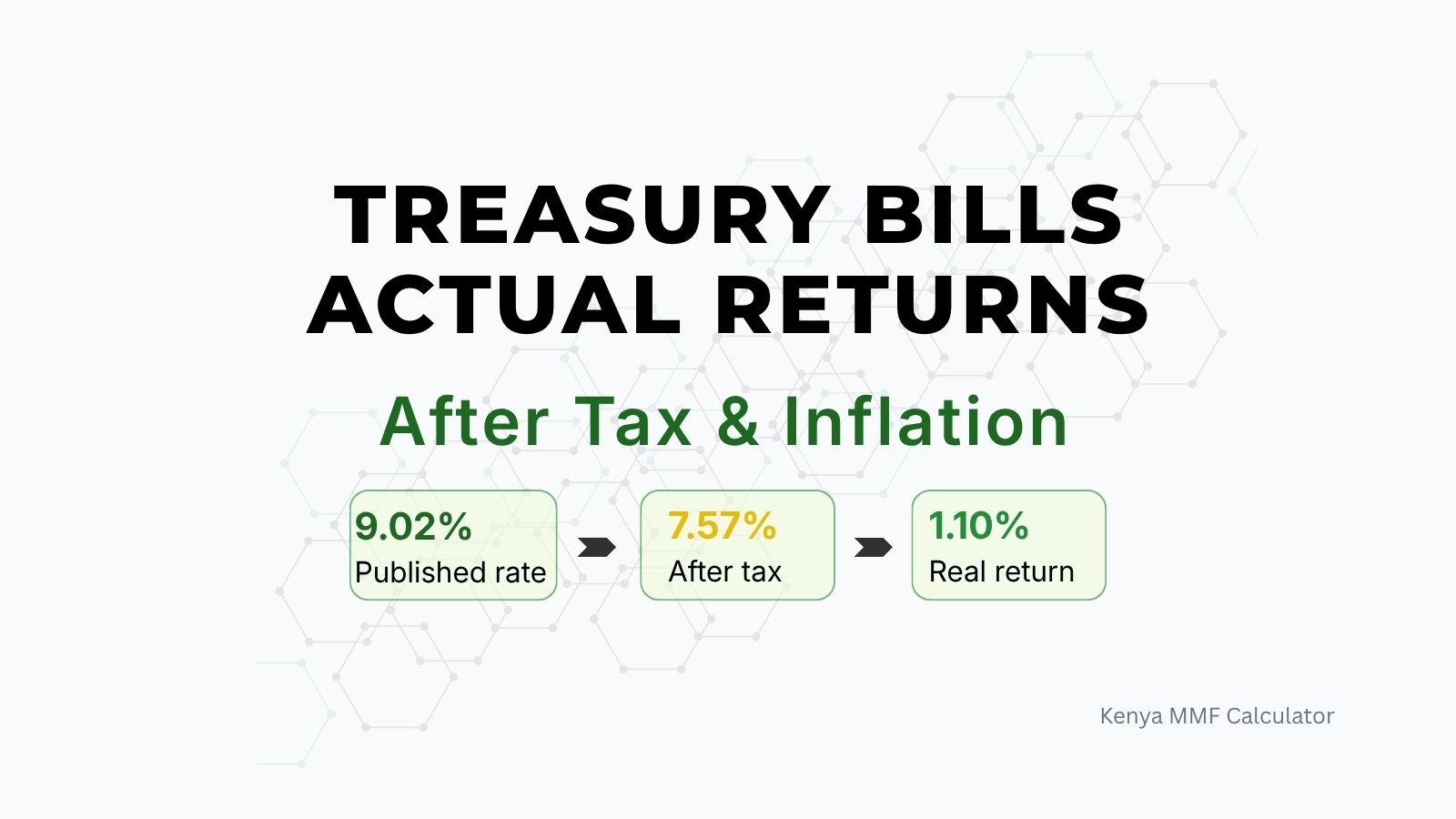
Treasury bills are often described as low-risk investments offering attractive interest rates. But if a 364-day Treasury bill has a published rate of 9.02%, does an investor really make 9.02%?
Not quite.
The published auction rate is only the starting point. To determine what you actually earn, you must account for how Treasury bills are priced, the 15% withholding tax on the interest and the loss of purchasing power caused by inflation.
Using the Treasury bill auction results dated 3 August 2026, this article calculates the approximate return on a KSh100,000 face-value investment. It also explains the difference between the advertised rate, the cash profit received at maturity and the investor’s real return after inflation.
Key takeaway: At a published rate of 9.02%, a 364-day Treasury bill with a face value of KSh100,000 produces an approximate cash profit of KSh7,015 after withholding tax. With inflation at 6.4%, the annualised increase in purchasing power is approximately 1.10%.
Treasury bill rates for 3 August 2026
The auction results used in this example reported the following market weighted average rates:
| Treasury bill | Published rate | Maturity date |
|---|---|---|
| 91-day | 8.79% | 2 November 2026 |
| 182-day | 8.95% | 1 February 2027 |
| 364-day | 9.02% | 2 August 2027 |
The same results showed inflation of 6.4% for June 2026. That figure is consistent with the Kenya National Bureau of Statistics’ June 2026 CPI release.
At first glance, an investor might subtract inflation from each auction rate and arrive at real returns of between 2.4% and 2.6%. However, that calculation leaves out tax and treats the quoted discount rate as though it were the investor’s final return.
How Treasury bills generate returns
Kenyan Treasury bills are short-term government securities issued in maturities of 91, 182 and 364 days. Unlike a conventional bond that pays periodic interest, a Treasury bill is normally sold below its face value.
You pay a discounted amount at the beginning and receive the full face value when the bill matures. The difference is the gross interest.
For example, you might obtain a Treasury bill with a face value of KSh100,000 while paying less than KSh100,000. At maturity, the government pays you KSh100,000. The Central Bank of Kenya describes the same discounted purchase structure in its guide to investing in government securities.
This matters because face value is not the same as the amount invested.
The Treasury bill pricing formula
The approximate discounted price can be calculated as follows:
\[\text{Discounted price}=\frac{\text{Face value}}{1+(\text{rate}\times\text{days}/365)}\]Gross interest is then:
\[\text{Gross interest}=\text{Face value}-\text{discounted price}\]Treasury bill interest is generally subject to 15% withholding tax. The tax is deducted from the interest at the start, which increases the total amount the investor must pay for the bill.
\[\text{Tax}=\text{Gross interest}\times15\%\] \[\text{Total amount paid}=\text{Discounted price}+\text{tax}\]Finally:
\[\text{Net cash profit}=\text{Face value}-\text{total amount paid}\]The CBK Treasury bill calculator follows this pricing structure and allows investors to calculate the price, tax and total offer payment. The Kenya Revenue Authority lists qualifying interest at a 15% withholding-tax rate for resident individuals.
Actual return on a 364-day Treasury bill
Consider a 364-day bill with:
- Face value: KSh100,000
- Published rate: 9.02%
- Term: 364 days
- Withholding tax: 15%
Step 1: Calculate the discounted price
\[\frac{100,000}{1+(0.0902\times364/365)}=KSh91,747.09\]Step 2: Calculate the gross interest
\[100,000-91,747.09=KSh8,252.91\]Notice that the gross interest is not KSh9,020. The 9.02% auction rate is used to price the bill; it is not simply multiplied by the KSh100,000 face value and paid to the investor.
Step 3: Calculate withholding tax
\[8,252.91\times15\%=KSh1,237.94\]Step 4: Calculate the total amount paid
\[91,747.09+1,237.94=KSh92,985.02\]Step 5: Calculate the cash profit
At maturity, the investor receives the KSh100,000 face value:
\[100,000-92,985.02=KSh7,014.98\]The investor therefore commits approximately KSh92,985 and earns approximately KSh7,015 over 364 days.
The net holding-period return on the cash actually committed is:
\[\frac{7,014.98}{92,985.02}\times100=7.54\%\]Because the bill runs for 364 rather than exactly 365 days, its approximate effective annualised net return is 7.57%.
Actual returns across all three Treasury bills
Applying the same method to a KSh100,000 face value for each tenor produces the following estimates:
| Treasury bill | Published rate | Approx. amount paid | Net cash profit | Return over bill’s term | Annualised net return |
|---|---|---|---|---|---|
| 91-day | 8.79% | KSh98,177.19 | KSh1,822.81 | 1.86% | 7.66% |
| 182-day | 8.95% | KSh96,368.73 | KSh3,631.27 | 3.77% | 7.70% |
| 364-day | 9.02% | KSh92,985.02 | KSh7,014.98 | 7.54% | 7.57% |
These calculations assume that the investor is subject to 15% withholding tax and holds the bill until maturity. Final pricing is determined by CBK and may differ slightly because of rounding and the accepted bid rate.
The annualised figures for the shorter bills also assume that returns can be reinvested at an equivalent rate. That is not guaranteed. When a 91-day or 182-day bill matures, the rate available at the next auction may be higher or lower.
Why a 91-day return is not 8.79%
The 8.79% rate shown for the 91-day bill is annualised. The bill is held for approximately one-quarter of a year.
On a KSh100,000 face value, the approximate net profit for the 91-day period is KSh1,823, not KSh8,790. To earn something close to the annualised figure over a full year, the investor would need to reinvest the proceeds several times at similar rates.
This creates reinvestment risk. A high rate today does not ensure that the next 91-day auction will offer the same return.
Nominal return versus real return
A positive account balance does not necessarily mean that your purchasing power grew by the same percentage.
The nominal return measures how many more shillings you have. The real return measures how much more those shillings can buy after inflation.
The common shortcut is:
\[\text{Real return}\approx\text{nominal return}-\text{inflation}\]This is useful for a quick estimate, but the more accurate formula is:
\[\text{Real return}=\frac{1+\text{nominal return}}{1+\text{inflation}}-1\]For the 364-day bill, using the annualised net return of 7.57% and inflation of 6.4%:
\[\frac{1.0757}{1.064}-1=1.10\%\]The investor’s purchasing power therefore grows by approximately 1.10%, assuming inflation remains at 6.4% over the relevant period.
Real Treasury bill returns after tax and inflation
| Treasury bill | Published rate | Annualised net return after tax | Real return at 6.4% inflation |
|---|---|---|---|
| 91-day | 8.79% | 7.66% | 1.18% |
| 182-day | 8.95% | 7.70% | 1.22% |
| 364-day | 9.02% | 7.57% | 1.10% |
This is considerably lower than the 2.4%–2.6% obtained by simply subtracting inflation from the published auction rates.
Inflation is also not fixed for the life of the investment. The 6.4% figure is the year-on-year inflation rate reported for June 2026, not a promise about inflation over the following 91, 182 or 364 days. The final real return can only be established using inflation over the investor’s actual holding period.
Does that make Treasury bills a poor investment?
Not necessarily.
A return slightly above inflation may still be valuable when the investor’s priorities are capital preservation, predictable maturity dates and relatively low credit risk. Treasury bills can also be useful for money that will be needed within a known period.
However, an investor should not interpret a 9.02% auction rate as a guaranteed 9.02% increase in purchasing power. After tax and inflation, the economic gain may be much smaller.
Treasury bills also carry risks and trade-offs:
- Inflation risk: Unexpectedly high inflation can reduce or eliminate the real return.
- Reinvestment risk: Shorter bills may mature when prevailing rates are lower.
- Liquidity considerations: An investor who needs the money before maturity may have to rediscount the bill.
- Opportunity cost: Other investments may earn more, although they may also carry greater risk.
- Rate uncertainty: Non-competitive bidders receive the auction’s accepted weighted average rate rather than choosing a guaranteed rate in advance.
Compare the same type of return
Investment comparisons are often misleading because different figures are placed side by side.
For example, someone may compare:
- a Treasury bill’s annualised rate before tax;
- a money market fund’s daily yield before fees or tax;
- a plot’s total price increase over ten years; and
- a business’s cash profit without valuing the owner’s time.
Those figures do not measure the same thing.
A fair comparison should ideally use returns that are:
- Net of taxes and direct costs
- Annualised over the same period
- Adjusted for inflation
- Evaluated alongside risk and liquidity
This does not mean the investment with the highest calculated return is automatically best. An emergency fund, for example, should not be placed in an illiquid investment merely because its projected long-term return is higher.
The same mistake appears in land banking
Land provides one of the clearest examples of why nominal gains can be deceptive.
Suppose someone buys a plot for KSh400,000 and sells it ten years later for KSh700,000. The seller may describe this as a KSh300,000 profit or a 75% return.
But 75% is the cumulative return over the entire ten years. The compound annual growth rate is only:
\[\left(\frac{700,000}{400,000}\right)^{1/10}-1=5.76\%\]If inflation averaged approximately 6% per year, the land would have lost purchasing power before accounting for legal fees, agent commissions, land rates, fencing, security, transport and capital gains tax.
The owner would have more shillings after selling the plot but could be economically worse off.
This does not prove that land is a bad investment. A well-located plot can appreciate substantially, generate income or acquire development value. It demonstrates that the purchase price and eventual sale price are not enough to judge the investment.
For a complete breakdown, see: Is Land Banking Profitable in Kenya? Calculating the Real Return After Inflation.
A practical checklist before investing
Before choosing a Treasury bill or comparing it with another investment, ask:
- Is the quoted rate gross or net of tax?
- Is it an annualised rate or the return for the actual investment period?
- How much cash will I pay at the beginning?
- How much will I receive at maturity?
- What taxes, fees or transaction costs apply?
- What happens if I need the money early?
- What inflation rate would reduce the real return to zero?
- Am I comparing this with alternatives on the same basis?
For the 364-day example above, inflation of approximately 7.57% would reduce the real return to about zero. Inflation above that level would mean the investment gained shillings but lost purchasing power.
Final thoughts
The 3 August 2026 Treasury bill rates of 8.79%, 8.95% and 9.02% looked comfortably higher than June’s 6.4% inflation rate. But the gap between the two was not the amount investors would actually gain in purchasing power.
After accounting for Treasury bill pricing and 15% withholding tax, the approximate annualised net returns fell to between 7.57% and 7.70%. Using 6.4% inflation, the corresponding real returns were only about 1.10% to 1.22%.
Treasury bills can still serve an important role in a portfolio. The lesson is simply to look beyond the headline rate.
Whether you are evaluating Treasury bills, money market funds, bonds, land or any other asset, calculate the return that remains after tax, costs and inflation. That is the figure that tells you whether your wealth actually grew.
FAQ
Is the Treasury bill auction rate the return I receive?
No. The published rate is used to calculate the bill's discounted price. Your actual return depends on the amount paid, the face value received at maturity, withholding tax and the length of the bill.
How are Treasury bill investors paid?
Treasury bills are generally purchased below face value. The investor pays the discounted purchase amount plus applicable tax and receives the full face value at maturity.
What tax applies to Treasury bills in Kenya?
Interest on ordinary Treasury bills is generally subject to 15% withholding tax. Tax rules can change, so investors should confirm the applicable treatment with CBK or KRA before investing.
What is the difference between nominal and real return?
Nominal return measures the increase in the number of shillings you hold. Real return adjusts that increase for inflation and therefore reflects the change in purchasing power.
Can a Treasury bill earn a negative real return?
Yes. If inflation exceeds the investor's return after tax, the investor can receive more shillings at maturity while still losing purchasing power.
Which Treasury bill had the highest return in this example?
On an annualised basis and assuming equivalent reinvestment, the 182-day bill produced the highest estimated net return at approximately 7.70%. The difference between the three bills was small, and future reinvestment rates are unknown.
Disclaimer: This content is for general informational purposes only and does not constitute financial advice. Read the full disclaimer.