Ziidi Trader Fees and Charges 2026: What It Really Costs to Buy and Sell Shares
September 08, 2026
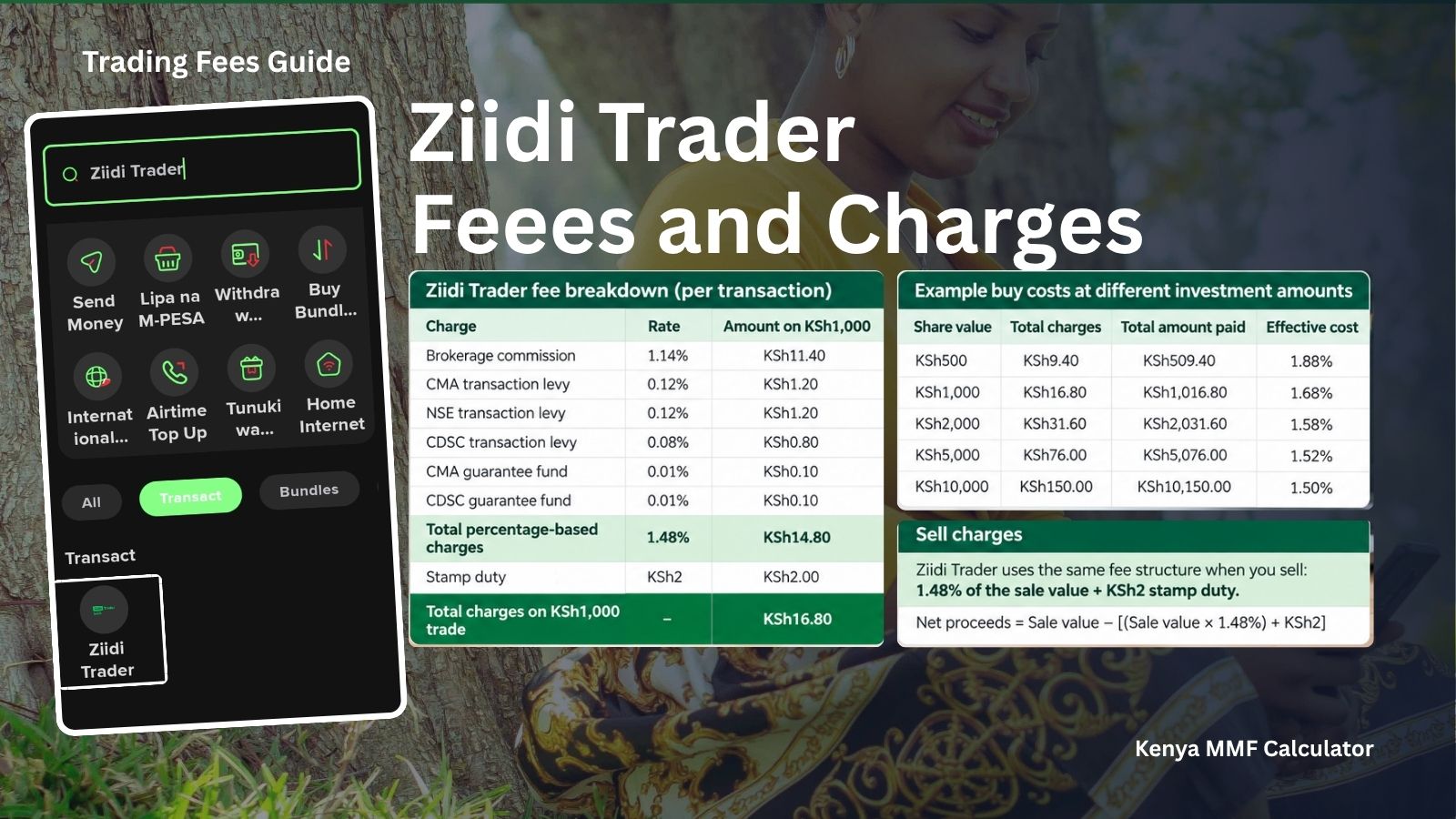
Ziidi Trader has made it much easier for M-PESA users to buy and sell shares on the Nairobi Securities Exchange (NSE), including very small quantities. However, the quoted share price is not the full cost of the transaction.
Ziidi Trader trades made through Safaricom My OneApp in September 2026 were charged 1.48% in percentage-based transaction costs, with stamp duty added separately. The percentage-based structure applies when buying and selling.
That means investors need to account for both the cost of entering a position and the cost of exiting it. A share trading above the price at which it was bought does not automatically mean the investor has made a net profit.
For a broader explanation of the service itself, read the complete Ziidi Trader guide.
Ziidi Trader fees at a glance
The charges applied to completed Ziidi Trader transactions were:
| Ziidi Trader charge | Rate |
|---|---|
| Brokerage commission | 1.14% |
| CMA transaction levy | 0.12% |
| NSE transaction levy | 0.12% |
| CDSC transaction levy | 0.08% |
| CMA guarantee fund | 0.01% |
| CDSC guarantee fund | 0.01% |
| Total percentage-based charges | 1.48% |
| Stamp duty | Charged separately according to transaction value |
The core transaction-cost formula is therefore:
Transaction charges = 1.48% of transaction value + applicable stamp duty
On a buy transaction:
Total amount paid = share value + charges
On a sell transaction:
Net amount received = sale value − charges
What each Ziidi Trader charge pays for
Brokerage commission
The brokerage commission is the largest single charge.
Ziidi Trader charged 1.14% of the transaction value as brokerage commission on the completed trades.
For every KSh1,000 traded:
KSh1,000 × 1.14% = KSh11.40
This is the brokerage cost associated with executing the securities transaction.
CMA transaction levy
Ziidi Trader charged a 0.12% Capital Markets Authority transaction levy.
The Capital Markets Authority regulates Kenya’s capital markets and licensed market intermediaries.
On KSh1,000:
KSh1.20
NSE transaction levy
A separate 0.12% NSE transaction levy was charged.
This is associated with executing the transaction through the Nairobi Securities Exchange.
On KSh1,000:
KSh1.20
CDSC transaction levy
Ziidi Trader charged a 0.08% CDSC transaction levy.
The Central Depository and Settlement Corporation provides the infrastructure used to electronically hold, clear and settle securities transactions.
On KSh1,000:
KSh0.80
CDSC’s published fee schedule also lists its equity transaction levy at 0.08% of equity turnover.
CMA guarantee fund
The completed trades also carried a 0.01% CMA guarantee fund charge.
On KSh1,000:
KSh0.10
This sits within the wider investor-protection framework of Kenya’s regulated capital markets.
CDSC guarantee fund
A separate 0.01% CDSC guarantee fund charge also applied.
On KSh1,000:
KSh0.10
Add all six percentage-based charges together:
1.14% + 0.12% + 0.12% + 0.08% + 0.01% + 0.01% = 1.48%
That 1.48% is the consistent percentage-based transaction cost charged before stamp duty is added.
How stamp duty works on Ziidi Trader transactions
Stamp duty is different from the percentage-based charges. On NSE transactions, the total charged is KSh2 for every KSh10,000 transacted. In practical terms, the charge rises in bands as the transaction value increases.
| Transaction value | Stamp duty |
|---|---|
| Up to KSh10,000 | KSh2 |
| Above KSh10,000 up to KSh20,000 | KSh4 |
| Above KSh20,000 up to KSh30,000 | KSh6 |
| Above KSh30,000 up to KSh40,000 | KSh8 |
As such, all low-value Ziidi Trader trades carry KSh2 in stamp duty, since they fall within the first KSh10,000 band. This is slighlty different from the Stamp Duty Act, where the schedule for contract notes states:
- KSh1 where the value of the stock or marketable security does not exceed KSh2,000;
- KSh2 where the value exceeds KSh2,000 but does not exceed KSh10,000; and
- another KSh2 for every KSh10,000, or fraction of KSh10,000, above KSh10,000.
Why stamp duty matters so much on very small trades
Stamp duty has a disproportionate effect on low-value transactions. The percentage-based charges scale directly with the value of the trade, buy stamp duty does not scale smoothly in the same way.
For example:
- On a KSh100 transaction, KSh2 is already 2% of the share value.
- On a KSh1,000 transaction, KSh2 is 0.2%.
- On a KSh10,000 transaction, KSh2 is only 0.02%.
This is why the effective cost of a very small trade can be significantly higher than the headline 1.48% figure suggests. It can be a major cost for investors using Ziidi Trader’s single-share trading feature.
Being able to buy one share makes the stock market more accessible, but not necessarily cost-efficient.
What different Ziidi Trader purchases can cost
The following examples use the 1.48% percentage-based transaction cost charged on Ziidi Trader trades together with the current KSh2-per-KSh10,000 stamp-duty treatment.
| Share value | Percentage charges | Stamp duty | Total charges | Total paid | Effective cost |
|---|---|---|---|---|---|
| KSh100 | KSh1.48 | KSh2 | KSh3.48 | KSh103.48 | 3.48% |
| KSh500 | KSh7.40 | KSh2 | KSh9.40 | KSh509.40 | 1.88% |
| KSh1,000 | KSh14.80 | KSh2 | KSh16.80 | KSh1,016.80 | 1.68% |
| KSh5,000 | KSh74.00 | KSh2 | KSh76.00 | KSh5,076.00 | 1.52% |
| KSh10,000 | KSh148.00 | KSh2 | KSh150.00 | KSh10,150.00 | 1.50% |
| KSh15,000 | KSh222.00 | KSh4 | KSh226.00 | KSh15,226.00 | 1.51% |
| KSh20,000 | KSh296.00 | KSh4 | KSh300.00 | KSh20,300.00 | 1.50% |
| KSh25,000 | KSh370.00 | KSh6 | KSh376.00 | KSh25,376.00 | 1.50% |
The percentage-based component remains 1.48%, but the relative effect of stamp duty changes. At ordinary trade sizes, the effective cost settles close to 1.5%, while at very small trade sizes, stamp duty pushes the effective percentage noticeably higher.
Ziidi Trader charges when you sell too
Ziidi Trader does not only charge when shares are bought.
Completed sell transactions carried the same six percentage-based charges:
- 1.14% brokerage commission
- 0.12% CMA levy
- 0.12% NSE levy
- 0.08% CDSC levy
- 0.01% CMA guarantee fund
- 0.01% CDSC guarantee fund
Together, those charges total 1.48%
Stamp duty also applied on the sell transaction.
The difference is simply where the cost is taken.
When buying, the fees increase the amount paid.
When selling, the fees reduce the amount received.
This is why transaction costs have to be considered on both sides of the investment.
How much must a share rise before you actually break even?
Take a KSh1,000 purchase.
The transaction costs are:
- KSh14.80 in percentage-based charges
- KSh2 stamp duty
- KSh16.80 total charges
The investor therefore spends:
KSh1,016.80
If the shares are sold later, another set of transaction charges applies.
For the investor to receive KSh1,016.80 after the sell charges are deducted, the shares need to be worth approximately:
KSh1,034.10
That means the share value has to increase by about:
3.41%
before the investor has simply recovered the buy and sell transaction costs.
Only gains above that point become trading profit, ignoring dividends and other factors.
The effect varies with investment size:
| Original share value | Approx. sale value needed to break even | Approx. rise required |
|---|---|---|
| KSh500 | KSh519.08 | 3.82% |
| KSh1,000 | KSh1,034.10 | 3.41% |
| KSh5,000 | KSh5,154.28 | 3.09% |
| KSh10,000 | KSh10,306.54 | 3.07% |
The KSh10,000 example crosses into the next stamp-duty band on the sale, so the sell-side stamp duty becomes KSh4.
The conclusion is straightforward:
A share price rising above your purchase price does not automatically mean the trade is profitable.
The increase first has to recover the costs of buying and selling.
Why frequent small trades deserve extra attention
Ziidi Trader makes it possible to invest with much less money than traditional share-trading structures once require, which is a major accessibility improvement.
However, frequent small transactions can accumulate costs quickly. An investor making several separate KSh500 purchases does not face the same effective cost as someone making one larger purchase of the same total value.
Each transaction carries its own charges.
The percentage-based fees remain proportional, while stamp duty can repeatedly hit the smallest trades harder as a percentage of the money being invested.
This makes transaction frequency part of the cost equation. As such, when using Ziidi Trader, don’t simply ask:
How many shares can I afford?
You should also understand:
What percentage of this transaction am I giving up in fees before the investment has even started moving?
Ziidi Trader is not Ziidi MMF
Ziidi Trader and Ziidi Money Market Fund serve different purposes.
Ziidi Trader is a securities trading service. Investors buy and sell NSE-listed securities whose prices can rise or fall.
Returns may come from:
- capital gains
- dividends
- other corporate actions
Ziidi MMF is a money market fund, with a completely different investment structure, fee model and return profile.
So, Ziidi interest rate, Ziidi MMF rate or Ziidi daily interest relate to the money market fund, not Ziidi Trader.
For the full comparison, read Ziidi Trader vs Money Market Funds in Kenya.
What to check before confirming a Ziidi Trader trade
Ziidi Trader displays the full charge breakdown before confirmation.
Before entering your M-PESA PIN, check:
- share price
- quantity
- total share value
- brokerage commission
- CMA transaction levy
- NSE transaction levy
- CDSC transaction levy
- CMA guarantee fund
- CDSC guarantee fund
- stamp duty
- total charges
- final amount payable or receivable
Those figures determine the real cost of the transaction.
Bottom line
Ziidi Trader charges 1.48% in percentage-based transaction costs when buying and selling shares. The largest component is the 1.14% brokerage commission. Stamp duty is added separately and currently follows the market’s KSh2-per-KSh10,000 charging structure.
For most ordinary trade sizes, the effective cost sits close to 1.5% on each side of the transaction, but it can be considerably higher for small trades because stamp duty represents a much larger share of the money invested.
Most importantly, investors pay transaction costs when they enter a position and again when they exit it. Knowing the share price is only half of the calculation. Knowing what it costs to buy, hold and eventually sell is what tells you whether the trade actually made money.
FAQs
How much does Ziidi Trader charge to buy shares?
Completed Ziidi Trader transactions in September 2026 were charged 1.48% in percentage-based transaction costs, plus applicable stamp duty.
Does Ziidi Trader charge fees when selling shares?
Yes. Completed sell transactions carried the same 1.48% in percentage-based charges, with stamp duty also applying.
What is the Ziidi Trader brokerage commission?
Ziidi Trader charged a brokerage commission of 1.14% of the transaction value. This was the largest individual percentage-based charge.
Is Ziidi Trader stamp duty a fixed KSh2 per transaction?
No. Stamp duty is charged according to transaction value. Current NSE market practice has been reported as KSh2 for every KSh10,000 transacted.
Why can very small Ziidi Trader trades be expensive?
The percentage-based charges remain 1.48%, but stamp duty can represent a large proportion of a very small transaction. This raises the effective cost of buying only a few low-priced shares.
Are Ziidi Trader fees the same as Ziidi MMF fees?
No. Ziidi Trader is a securities trading service for buying and selling NSE-listed investments, while Ziidi MMF is a money market fund with a different return and fee structure.
Disclaimer: This content is for general informational purposes only and does not constitute financial advice. Read the full disclaimer.