Mansa-X Dominates as Kenya’s Fund Market Hits KSh 851.7 Billion
June 13, 2026
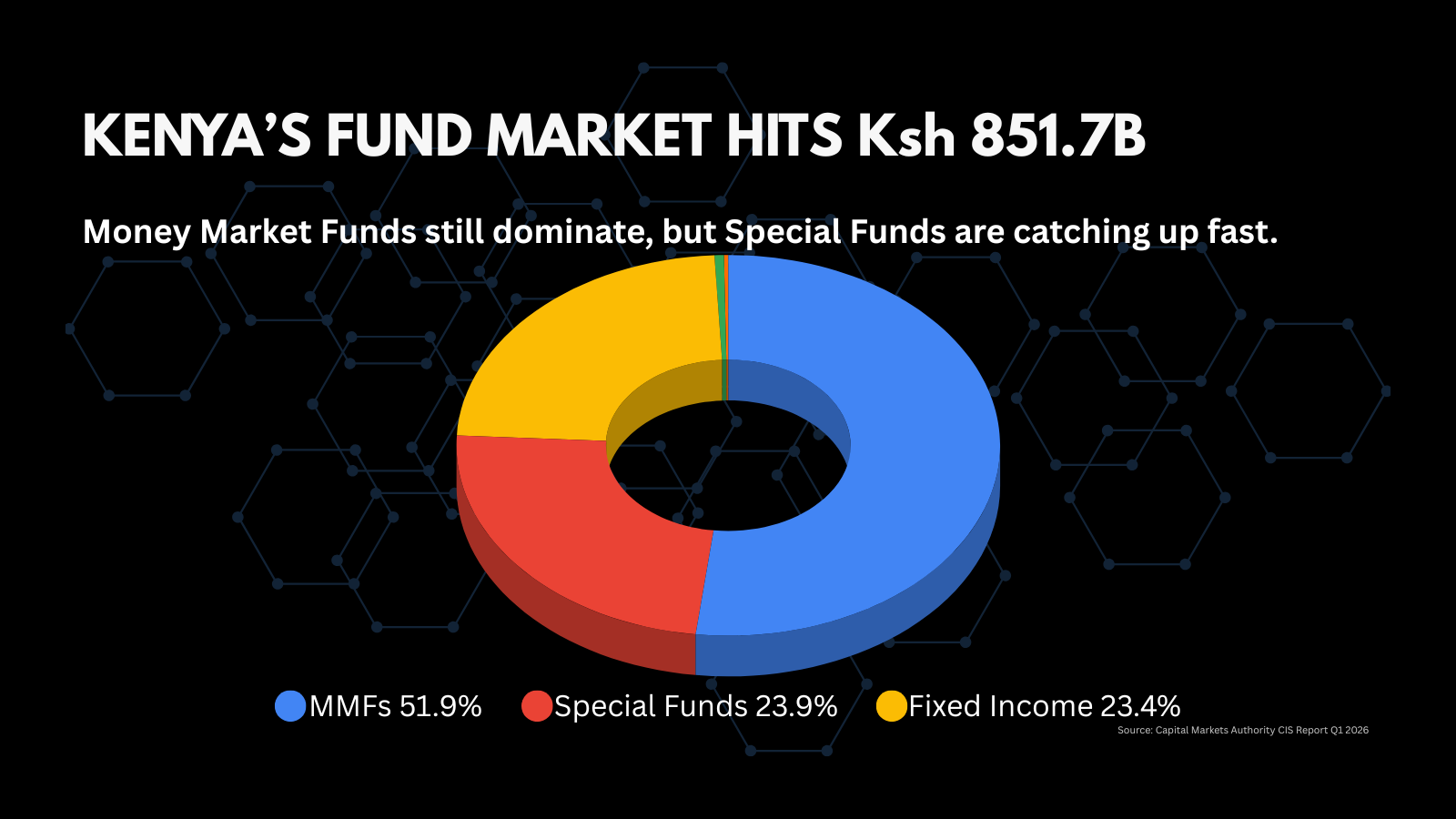
Kenya’s regulated fund market is growing fast, and the latest CMA report shows just how competitive it has become.
According to the Capital Markets Authority’s Collective Investment Schemes Quarterly Report for the period ended March 31, 2026, total assets under management in Kenya’s CIS market reached KSh 851.7 billion.
That was up from KSh 756.3 billion in December 2025.
In simple terms, Kenya’s collective investment schemes added about KSh 95.4 billion in just one quarter.
The most interesting part is what happened at the top of the market. Sanlam Unit Trust Scheme remained number one, but Standard Investment Trust Fund, backed by the rise of Mansa-X, moved very close behind.
For Kenyan investors, this is a useful moment to understand the difference between Money Market Funds, Special Funds, and other collective investment schemes.
Q2 2026 update: Standard Investment Trust Fund, the umbrella scheme containing the four Mansa-X funds, has since overtaken Sanlam to become Kenya’s largest collective investment scheme, with KSh 188.6 billion in assets under management. Read our complete Mansa-X Special Fund Kenya guide for the latest returns, fees, minimum investment, lock-in period, withdrawals and risks.
Kenya’s CIS market reached KSh 851.7 billion in Q1 2026
The CMA report shows that Kenya had 62 approved Collective Investment Schemes made up of 285 funds by the end of March 2026. Out of these, 43 were active.
The total market stood at KSh 851.7 billion, a 13% increase from the previous quarter.
This growth shows that more Kenyans are moving money into regulated investment products. It also shows that investors are not only looking at bank savings accounts anymore. Many are now comparing Money Market Funds, Fixed Income Funds, Special Funds, and other fund options.
That is good for the market, but it also makes comparison more important.
A bigger market gives investors more choice. It also means investors need to understand what they are buying before chasing returns.
The biggest collective investment schemes in Kenya
The CMA ranked the largest collective investment schemes by assets under management as follows:
| Rank | Unit Trust Scheme | AUM as of March 2026 | Market Share |
|---|---|---|---|
| 1 | Sanlam Unit Trust Scheme | KSh 161.0 billion | 18.9% |
| 2 | Standard Investment Trust Fund | KSh 153.2 billion | 18.0% |
| 3 | CIC Unit Trust Scheme | KSh 103.2 billion | 12.1% |
| 4 | Britam Unit Trust Scheme | KSh 61.9 billion | 7.3% |
| 5 | NCBA Unit Trust Scheme | KSh 54.3 billion | 6.4% |
Sanlam was still the largest player in Kenya’s CIS market.
But Standard Investment Trust Fund was not far behind.
Sanlam had KSh 161.0 billion, while Standard Investment Trust Fund had KSh 153.2 billion. That is a gap of about KSh 7.9 billion.
In a market of more than KSh 851 billion, that is a close race.
Mansa-X is the main story behind Standard Investment Trust Fund’s rise
Standard Investment Trust Fund grew from KSh 125.3 billion in December 2025 to KSh 153.2 billion in March 2026.
That was a 22% quarterly increase.
A major reason Standard Investment Trust Fund stands out is the size of its Mansa-X Special Funds.
In the CMA report, Mansa-X appears under the Special Funds category. The largest Mansa-X fund was the Mansa-X Special Fund KES, with KSh 132.2 billion in assets.
The Mansa-X Special Fund USD had KSh 17.4 billion.
The report also listed Mansa-X Shariah Special Fund KES and Mansa-X Shariah Special Fund USD under Standard Investment Trust Fund.
Here is how the main Mansa-X funds appeared in the Special Funds section:
| Fund | Category | AUM as of March 2026 |
|---|---|---|
| Mansa-X Special Fund KES | Special Fund | KSh 132.2 billion |
| Mansa-X Special Fund USD | Special Fund | KSh 17.4 billion |
| Mansa-X Shariah Special Fund KES | Special Fund | KSh 3.0 billion |
| Mansa-X Shariah Special Fund USD | Special Fund | KSh 527.9 million |
This explains why many investors are searching for terms like Mansa-X fund, Mansax fund, Mansa-X investment, Standard Investment Bank, and SIB.
Mansa-X has become one of the most visible names in Kenya’s regulated fund market.
Standard Investment Bank, SIB Global Markets, and Mansa-X
Mansa-X is commonly associated with Standard Investment Bank, also known as SIB.
SIB describes Mansa-X as the flagship product of its Global Markets division. The fund is positioned as a multi-asset strategy fund with exposure to different asset classes, including currencies, precious metals, commodities, stock indices, selected stocks, cash, and fixed income.
That is very different from a normal Money Market Fund.
A Money Market Fund usually focuses on lower-risk, short-term assets such as Treasury bills, fixed deposits, call deposits, and other short-term instruments.
Mansa-X, on the other hand, is listed in the CMA report as a Special Fund.
That difference matters.
Mansa-X is not the same as a Money Market Fund
It is easy to compare investment products by return alone, but that can be misleading.
A Money Market Fund and a Special Fund can have very different objectives, risks, fees, and withdrawal terms.
Money Market Funds are usually used for:
- Emergency savings
- Short-term savings goals
- Parking idle cash
- Business cash management
- Earning a return while keeping liquidity
Special Funds may have a wider investment mandate. They may invest across different markets or asset classes, depending on the fund’s strategy.
This does not make one better than the other.
It simply means they should not be compared as if they are the same product.
Before comparing Mansa-X with a Money Market Fund, investors should first ask:
- What type of fund is it?
- What assets does it invest in?
- What fees apply?
- Is there a lock-in period?
- How fast can I withdraw?
- Is the return gross or net?
- What risks does the strategy carry?
- Is past performance being used correctly?
The most important lesson is simple:
Compare fund type before comparing returns.
Special Funds are growing quickly
Money Market Funds still dominate Kenya’s CIS market, but Special Funds are growing fast.
The CMA report shows that Special Funds had KSh 203.6 billion in assets under management in Q1 2026. That represented 23.9% of the total CIS market.
Special Funds also grew by 25% from the previous quarter.
The biggest Special Funds in the CMA report included:
| # | Special Fund | AUM as of March 2026 | Share of Special Funds |
|---|---|---|---|
| 1 | Mansa-X Special Fund KES | KSh 132.2 billion | 64.9% |
| 2 | Mansa-X Special Fund USD | KSh 17.4 billion | 8.6% |
| 3 | Oak Multi Asset Special KES Fund | KSh 15.5 billion | 7.6% |
| 4 | Madison Wealth Special Fund | KSh 8.8 billion | 4.3% |
| 5 | Britam Special Fund Fixed Income Fund | KSh 6.5 billion | 3.2% |
This is why terms like Oak Special Fund, Etica, and Arvocap are also becoming more relevant.
The CMA report listed Oak Multi Asset Special KES Fund under Faida Unit Trust Funds. It also listed Etica Special Fund Multi Asset Fund, Etica Special Fund Wealth Fund, and Arvocap special funds such as Arvocap Multi Asset Strategy Special Fund and Arvocap Africa Equity Fund Special Fund.
This shows that investor interest is expanding beyond traditional Money Market Funds.
Money Market Funds still dominate Kenya’s fund market
Even with the rise of Mansa-X and other Special Funds, Money Market Funds remain the largest category in Kenya.
The CMA report shows that Money Market Funds held KSh 442.2 billion in assets under management in Q1 2026.
That was about 51.9% of the entire CIS market.
So, for every KSh 100 invested in collective investment schemes, about KSh 52 was in Money Market Funds.
That makes sense.
MMFs are popular because they are relatively easy to understand. They are also useful for people who want a balance between liquidity, stability, and return.
For many Kenyan investors, a Money Market Fund is often the first step before exploring Fixed Income Funds, Special Funds, or other products.
The largest Money Market Funds in Kenya
The CMA report ranked SanlamAllianz Money Market Fund as the largest Money Market Fund in Q1 2026.
It had KSh 123.4 billion in AUM.
It was followed by CIC Money Market Fund, which had KSh 75.1 billion.
Here are the top Money Market Funds by AUM:
| Rank | Money Market Fund | AUM as of March 2026 | MMF Market Share |
|---|---|---|---|
| 1 | SanlamAllianz Money Market Fund | KSh 123.4 billion | 27.9% |
| 2 | CIC Money Market Fund | KSh 75.1 billion | 17.0% |
| 3 | Old Mutual Money Market Fund | KSh 26.8 billion | 6.1% |
| 4 | ABSA Shilling Money Market Fund | KSh 24.9 billion | 5.6% |
| 5 | Co-op Money Market Fund | KSh 21.8 billion | 4.9% |
| 6 | ICEA LION Money Market Fund | KSh 20.4 billion | 4.6% |
| 7 | KCB Money Market Fund KES | KSh 19.4 billion | 4.4% |
| 8 | Ziidi Money Market Fund | KSh 18.2 billion | 4.1% |
| 9 | Britam Money Market Fund | KSh 15.5 billion | 3.5% |
| 10 | Jubilee Money Market Fund KES | KSh 12.5 billion | 2.8% |
This list shows that the MMF market is still led by large, familiar names. However, newer and fast-growing funds are also gaining attention.
What this means for ordinary Kenyan investors
The growth of Mansa-X, Special Funds, and Money Market Funds shows that Kenya’s investment market is changing.
More people are looking for better ways to grow their money. More fund managers are competing for investor attention. More products are being marketed online, on social media, through podcasts, and through financial content creators.
That is good, but it also creates a risk.
Investors may start comparing products that are not the same.
For example, a Money Market Fund, a Fixed Income Fund, a Special Fund, and an Equity Fund can all be regulated investment products. But they can behave very differently.
A fund with a higher return may also have higher risk.
A fund with a large AUM may not be the best fit for your personal goals.
A popular fund may still have fees, withdrawal conditions, or lock-in terms that you need to understand before investing.
AUM is important, but it is not everything
Assets under management can tell you how large a fund is.
A large AUM may suggest investor confidence, strong distribution, or a trusted brand. It can also show that a fund has attracted significant inflows.
But AUM does not tell you everything.
It does not tell you whether the fund has the best net return. It does not tell you whether the fees are low. It does not tell you whether the fund is suitable for emergency savings, school fees, rent, business cash, or long-term wealth building.
AUM is only one part of the picture.
Before choosing a fund, compare:
- Fund type
- Historical returns
- Fees
- Withholding tax
- Minimum investment
- Withdrawal period
- Lock-in period
- Risk level
- Assets held by the fund
- Fund manager reputation
- CMA regulatory status
Why net return matters when comparing MMFs
For Money Market Funds, the headline rate is not always the final amount you receive.
Investors should check whether the quoted return is gross or net. They should also remember that withholding tax and fees can affect the final return.
This is why comparing MMFs by advertised yield alone can be misleading.
A fund may quote an attractive annual rate, but the actual amount you receive depends on:
- How much you invest
- How long you keep the money invested
- Fees charged by the fund
- Withholding tax
- Whether income is compounded or paid out
- How the fund calculates returns
You can use the Kenya MMF Calculator to estimate your possible Money Market Fund returns after fees and withholding tax.
This is especially useful now that more Kenyans are comparing MMFs, Special Funds, and other investment products.
Final thoughts
The CMA Q1 2026 report shows that Kenya’s collective investment schemes market is no longer small.
The market reached KSh 851.7 billion by March 2026.
Sanlam remained the largest CIS provider, but Standard Investment Trust Fund moved very close behind, largely because of the size of the Mansa-X fund under the Special Funds category.
At the same time, Money Market Funds remained the biggest category overall, holding KSh 442.2 billion.
For investors, the main lesson is not that one fund is automatically better than another.
The real lesson is that Kenya’s investment landscape is becoming more competitive.
Mansa-X, Sanlam, CIC, Etica, Oak Special Fund, Arvocap, and other fund names will continue attracting attention. But investors should go beyond the name and ask what each fund actually does.
Before investing, check the fund type, fees, risk level, liquidity, lock-in period, historical performance, and whether the product matches your goals.
The best fund is not always the biggest one.
The best fund is the one that fits your money, your timeline, and your risk level.
FAQs
Is Mansa-X a Money Market Fund?
No. In the CMA Q1 2026 CIS report, Mansa-X is listed under Special Funds, not Money Market Funds.
Who owns or operates the Mansa-X fund?
Mansa-X is associated with Standard Investment Bank through SIB Global Markets.
Which is the largest collective investment scheme in Kenya?
According to the CMA Q1 2026 CIS report, Sanlam Unit Trust Scheme was the largest collective investment scheme in Kenya with KSh 161.0 billion in assets under management.
How close is Standard Investment Trust Fund to Sanlam?
Standard Investment Trust Fund had KSh 153.2 billion in assets under management in Q1 2026, while Sanlam had KSh 161.0 billion. The difference was about KSh 7.9 billion.
How big are Money Market Funds in Kenya?
Money Market Funds held KSh 442.2 billion in assets under management in Q1 2026, representing about 51.9 percent of the market.
Disclaimer: This content is for general informational purposes only and does not constitute financial advice. Read the full disclaimer.